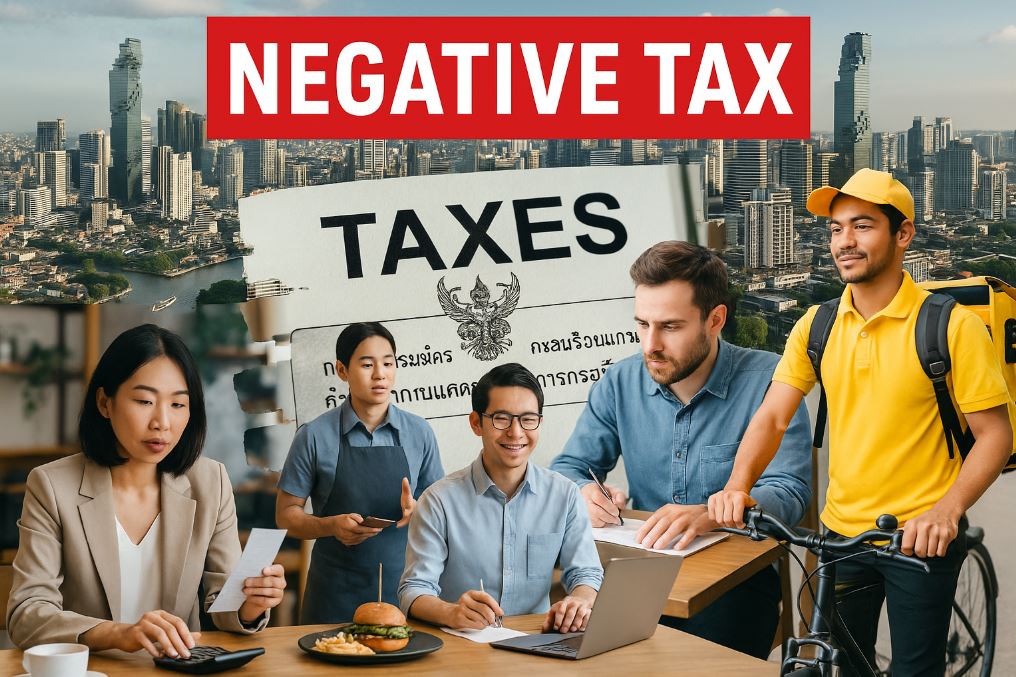
Thailand will introduce a negative income tax (NIT) system in 2027, requiring all workers and businesses to file tax returns as part of a plan to expand welfare coverage and boost revenue collection.
This will make filing personal income tax forms mandatory for all workers, regardless of earnings, and extend the same obligation to business operators through corporate income tax forms.
The Finance Ministry said every citizen in the workforce must submit a personal income tax form, while business operators are required to file corporate income tax forms. Currently, only about 6% of Thailand’s 67 million people pay income tax.
Under the new system, people earning up to 150,000 baht ($4,100) annually will not pay taxes and will qualify for welfare benefits. Higher earners will be taxed at progressive rates, starting at 5% and rising to 35% for income over 5 million baht.
Officials said the system will replace fragmented subsidies and create a single channel for financial support. A new national “data lake” will integrate tax and welfare information, covering more than 60 million people and 600,000 businesses. The data will also be used to detect tax evasion and improve budget planning.
Expats and foreign residents in Thailand might also qualify for the negative income tax if they are considered Thai tax residents, which usually means spending at least 180 days in the country each year. However, most long-term or retirement visa holders are unlikely to benefit from the welfare programs because they are designed for lower-income citizens, and visa rules require higher financial thresholds. The rules regarding foreign-sourced income are still unclear and await official guidance from the Revenue Department (RD), Cabinet, or Council of State.
Additionally, the ministry plans to raise the value-added tax, which has stayed at 7% for over two decades. Officials argue that a higher VAT will capture more revenue from high-income consumers and provide infrastructure, education and public health funds.
According to analysts, implementing NIT depends on political developments, including possible elections before 2027. Some politicians have voiced concerns about verifying income within Thailand’s informal economy, which could influence the final rules. Compared to neighboring countries, which typically restrict taxation of foreigners to income earned locally, Thailand’s approach presents new uncertainties for expats and foreign residents.