
Register a Company in Thailand Without a Thai Partner in 2025: What Are the Options?
Essential aspects of Thai company incorporation for doing business legally in Thailand
Have you ever wondered if you can register a company in Thailand without a Thai partner? Yes, you can! And here’s how.
Many foreigners who want to start a business in Thailand are unsure about local ownership rules. While it’s true that Thai law restricts foreign ownership in many sectors, there are legal ways to own 100% of your business in Thailand without relying on risky nominee structures.
In this guide, we explain your options for starting a business in Thailand as a foreigner in 2025, how to legally register a Thai company without a Thai partner and what to avoid. Whether you’re launching a startup, setting up a branch or expanding your company, this article will help you choose the right structure for full control and compliance.
Can You Legally Own 100% of a Company in Thailand as a Foreigner?
Thailand has restrictions on foreign ownership of businesses, but that doesn’t mean 100% ownership is impossible.
Under the Foreign Business Act (FBA), foreigners are generally limited to owning no more than 49% of shares in a Thai company if the business operates in certain restricted sectors, such as retail, construction or accounting services. These restricted activities are listed in LISTS ANNEXED TO THE FOREIGN BUSINESS ACT, B.E. 2542 (1999).
However, the law also provides exceptions. In some cases, foreigners can legally and transparently own 100% of a Thai company by using special approvals or business structures.
There are currently four main legal ways to register a company in Thailand without a Thai partner:
- Through the BOI (Board of Investment) promotion
- Under the U.S.-Thailand Treaty of Amity (for U.S. citizens)
- As a representative office or branch office
- And, in rare cases, as a Foreign Business License (FBL) holder
Remember that each option comes with its own conditions, costs and limitations, but they all offer a path to full control without using illegal nominee shareholders.
A BRIEF OUTLOOK:
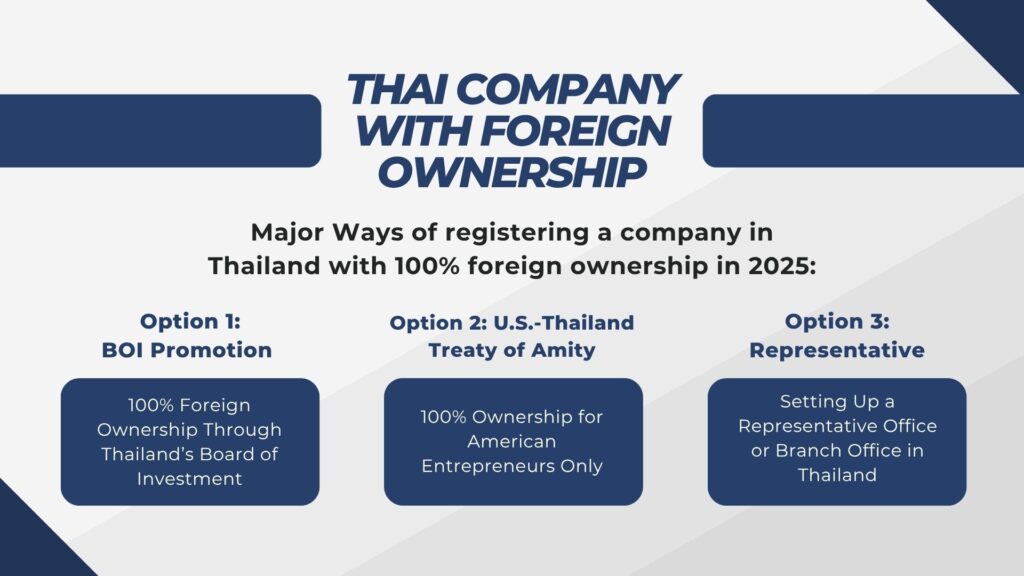
Let’s have a look in each options of registering a company in Thailand without a Thai partner in more details:
Option 1: BOI Promotion – 100% Foreign Ownership Through Thailand’s Board of Investment
What is BOI Promotion?
The Thailand Board of Investment (BOI) is a government agency under the Prime Minister’s Office that promotes investment with tax and non‑tax incentives, including 100% foreign ownership for approved projects.
Who Qualifies?
BOI targets industries that support Thailand’s national goals:
- High-tech manufacturing, digital tech, semiconductors, R&D, renewables, EVs, smart agriculture, etc.
- Projects must meet certain criteria:
- Minimum capital (often ≥ 50 million THB for land ownership).
- Must show added economic value (e.g., R&D, job creation)
- Environmental standards and quality systems like ISO may be required
What Are the Benefits?
- 100% Foreign Ownership & Foreign Business Certificate
BOI‑promoted companies are not subject to the 49% foreign ownership cap under the FBA – they receive a Foreign Business Certificate to operate fully as a foreign entity.
- Corporate Tax & Duty Incentives
- Up to 8–13 years of corporate income tax exemption, depending on industry and location
- Exemptions on import duties for machinery, raw materials, and R&D goods
- Additional deductions on utility and infrastructure costs, plus possible VAT relief on machinery
- Land Ownership
BOI‑approved foreign entities can own land for business purposes (e.g., offices, factories, staff housing).
- Must have ≥ 50 million THB paid‑up capital.
- Up to 5 rai for offices, 10 rai for executive housing, 20 rai for worker housing
- Visa & Work Permit Facilitation
- One‑Stop Service Center supports visa/work permit processing.
- No 4:1 Thai-to-foreign employee quota.
- Spouses and children also eligible for visas
- Currency & Investment Protections
- Free foreign currency remittance.
- Protection against nationalization and discrimination
Process at a Glance
- Identify eligible activity and gather documentation.
- Submit online BOI application, including business plan, capital, environmental and tech details.
- BOI assessment and interview.
- Award of Investment Promotion Certificate listing incentives.
- Register company with DBD under BOI privileges.
- Comply with conditions (e.g., timelines, reporting). Failure may revoke privileges
Pros and Cons
| Pros | Cons |
|---|---|
| Full 100% foreign ownership | Application can take months |
| Major tax & duty savings | Requires compliance & regular audits |
| Land ownership possible | Minimum capital & sector requirements |
| Easy visas, permits, currency controls | Restricted to BOI‑approved activities |
| Better environment for foreign talent |
If your business fits one of these BOI‑promoted activities, this route offers maximum control, strong incentives and long-term stability for foreign entrepreneurs in Thailand.
Option 2: U.S.-Thailand Treaty of Amity – 100% Ownership for American Entrepreneurs Only
If you’re a U.S. citizen looking to start a business in Thailand without a Thai partner, the Treaty of Amity and Economic Relations between the United States and Thailand offers one of the most straightforward legal paths to 100% foreign ownership.
What Is the Treaty of Amity?
The Treaty of Amity, signed in 1966, allows American citizens and U.S.-incorporated companies to establish and operate businesses in Thailand with equal rights to Thai nationals in most sectors. It provides a special exemption from the FBA’s usual restrictions on foreign ownership, which means qualifying businesses can be 100% American-owned without applying for an FBL.
This route is available only to U.S. citizens and entities that are majority U.S.-owned and U.S.-controlled.
What Types of Businesses Are Allowed?
Under the Treaty, Americans can fully own companies engaged in:
- Service businesses (consulting, tech, marketing, etc.)
- Wholesale and retail trade
- Manufacturing and export activities
However, there are exceptions. Certain industries remain restricted even under the treaty, including:
- Land trading and development
- Natural resources and agriculture
- Banking, finance, insurance
- Domestic transportation and communications
These restrictions follow the same general lines as Annex 1 and 2 of the FBA.
Key Requirements for U.S. Treaty Companies
To qualify for protection under the treaty, a company must:
- Be at least 51% owned by U.S. citizens or U.S.-registered entities
- Have a board of directors with at least 50% American nationals
- Be registered in Thailand (or in the U.S., depending on the structure)
- Maintain minimum capital of THB 2 million for unrestricted activities, or THB 3 million per activity for those under FBA Annex 3
You’ll also need to apply for a Foreign Business Certificate (FBC) through Thailand’s Ministry of Commerce after receiving verification from the U.S. Embassy in Bangkok.
Application Process: Step by Step
- Company Setup
Incorporate the business in Thailand and prepare your corporate documents, including shareholder structure and director details.
- Embassy Verification
Apply for a Letter of Certification from the U.S. Commercial Service confirming that your company meets treaty ownership and control requirements.
- Submit to Thai Authorities
With the embassy letter, submit your application to the Ministry of Commerce to obtain a FBC.
- Approval Timeline
The process typically takes 4 to 6 weeks from submission to final approval. Once approved, the company may operate as a fully U.S.-owned entity.
Benefits of Using the Treaty of Amity
The biggest advantage is full legal ownership without the need for Thai shareholders. Treaty companies also enjoy “national treatment,” meaning they are treated as if they were Thai-owned for most business purposes. This can simplify certain processes like obtaining business licenses, signing contracts or entering joint ventures.
In addition, these companies generally find it easier to apply for business visas and work permits for foreign staff, and they avoid the restrictions placed on other foreign-owned entities under the FBA.
Downsides and Limitations
The Treaty of Amity has important limitations to consider. It applies only to U.S. citizens, so it’s not an option for other nationalities. It also doesn’t allow participation in high-barrier industries like finance or agriculture, and treaty companies are still not allowed to own land in Thailand, even though long-term leases remain an option.
Moreover, maintaining treaty status requires strict adherence to ownership and board composition rules. If these change (e.g., U.S. shareholders sell their shares), the company may lose its FBC status.
If you’re a U.S. entrepreneur planning to register a company in Thailand without a Thai partner, the Treaty of Amity provides a clear legal route with long-term protection. Just make sure to comply with the requirements and work with a service provider that can manage the process for you from start to finish.
Option 3: Setting Up a Representative Office or Branch Office in Thailand
If you already own a company overseas, another legal way to operate in Thailand without a Thai partner is by setting up a representative office or a branch office. Both options allow for 100% foreign ownership, as they are extensions of a foreign legal entity and not Thai-registered companies with local shareholders.
What Is a Representative Office?
A representative office is a non-revenue-generating entity. It can carry out certain support or liaison activities for its parent company, but it is not allowed to earn income or sign contracts in Thailand.
Permitted activities include:
- Market research and feasibility studies
- Product sourcing and quality control
- Reporting business trends and market opportunities
- Promoting products or services of the head office
- Coordinating after-sales support (without billing clients)
Representative offices are ideal for foreign companies that want to test the Thai market, build local partnerships or coordinate operations without conducting commercial activity.
Key Features:
- 100% foreign ownership allowed
- No need for a Thai partner or local shareholders
- Cannot generate revenue or issue invoices
- Exempt from corporate income tax (since it earns no income)
- Must have minimum THB 2 million capital, injected in stages over 2 years
- Must appoint at least one local staff member and a foreign director (optional)
What Is a Branch Office?
Unlike a representative office, a branch office can conduct business and earn revenue in Thailand, but it is still not a separate legal entity as it operates as a branch of the foreign head office.
Branch offices are commonly used for:
- Delivering services to Thai clients
- Executing government contracts or foreign-invested projects
- Expanding operations with limited local liability
However, branch offices must apply for an FBL if the business activity falls under restricted categories under the FBA. Approval depends on the activity and sector.
Key Requirements:
- 100% foreign ownership permitted
- Subject to Thai corporate income tax on income earned in Thailand (20%)
- Must inject THB 3 million in capital per restricted activity
- Parent company remains legally responsible for liabilities
Pros and Cons
| Feature | Representative Office | Branch Office |
|---|---|---|
| Can generate revenue? | NO | YES |
| Needs FBL? | NO | YES (if activity is restricted) |
| Capital requirement | 2 million THB | 3 million+ THB |
| Tax liability | None | Yes (20% CIT) |
| Ownership | 100% foreign | 100% foreign |
| Common use | Market research, liaison | Service delivery, contracts |
When to Choose These Structures
Choose a representative office if you’re not ready to trade yet but want a legal presence in Thailand for research, coordination or branding.
Choose a branch office if you’re a foreign company delivering services in Thailand or fulfilling contracts under your overseas name, but only if you want to avoid setting up a full local subsidiary.
Both models are fully legal, transparent and require no Thai shareholders, making them popular among multinational companies, consulting firms, logistics providers and trading businesses entering Thailand.
Thai Nominee Shareholders – Why You Should Avoid This Risky Shortcut
If you’ve done some research on how to register a company in Thailand without a Thai partner, you’ve probably come across the idea of using Thai nominee shareholders. While this approach may seem like a fast and easy workaround to get 100% control, it’s important to understand that this structure is illegal and increasingly under government scrutiny.
What Are Thai Nominee Shareholders?
A nominee structure is when a Thai national holds shares in a company on behalf of a foreigner, but does not exercise any real control, investment, or decision-making power. In practice, the foreigner funds the company and runs it, while the Thai partner is a “name-only” shareholder, often paid a fee for the role.
This setup is commonly used to fake compliance with the 49/51 ownership rules under the FBA.
Why It’s a Problem
While this may have been common practice in the past, it is considered a violation of Thai law, specifically:
- Section 36 of the Foreign Business Act, which prohibits foreigners from using Thai nominees to bypass ownership limits.
- The use of a Thai national as a proxy to hold shares without true investment or risk is classified as disguised foreign ownership — and is criminally punishable.
Thai authorities have significantly increased investigations into nominee structures, especially in the wake of:
- Rising concerns about illegal foreign control in sensitive sectors (real estate, tourism, services)
- Pressure to align with anti-money laundering and foreign investment transparency standards
- A government crackdown starting in 2022, including joint efforts between the Ministry of Commerce and Department of Special Investigation (DSI)
Real Consequences of Using Nominees
If caught using nominee shareholders, foreign business owners may face:
- Revocation of business licenses
- Forced closure of the company
- Fines and possible imprisonment
- Permanent blacklisting from doing business in Thailand
Additionally, nominee agreements are not enforceable in Thai courts. If something goes wrong, for example, if the Thai nominee claims ownership or refuses to sign, the foreign party has no legal protection.
What You Should Do Instead
If you want to own 100% of a company in Thailand, there are legal and safe alternatives:
- Apply for BOI promotion in eligible sectors
- Use the Treaty of Amity if you’re a U.S. citizen
- Establish a branch office or representative office for overseas expansion
- Explore joint ventures with genuine Thai partners where the partnership is strategic and transparent
Three Legal ways to meet Thai ownership requirements
THAI LOCAL SHAREHOLDERS ALTERNATIVES – PLEASE READ OUR FULL GUIDE HERE
These options may involve more planning or documentation, but they protect you legally, ensure long-term stability and maintain your professional credibility in Thailand.
Thai nominee shareholder setups are not worth the risk. The Thai government is actively cracking down on these illegal structures, and penalties are severe. It’s always better to use a compliant structure, and if you’re unsure which route is right, consult an expert to guide you through the process safely.
Comparing Your Options and Choosing the Right Path
Now that you’ve seen all the legal ways to register a company in Thailand without a Thai partner, let’s compare them side by side.
| Option | 100% Foreign Ownership? | Ideal For | Key Requirements | Limitations |
|---|---|---|---|---|
| BOI Promotion | YES | Tech, manufacturing, export, R&D, startups | Must meet BOI criteria; apply for approval | Limited to promoted sectors; requires strict compliance |
| Treaty of Amity (U.S.) | YES | U.S. citizens in service-related businesses | Proof of U.S. citizenship; certificate from Thai government | Not available to non-U.S. nationals; some restricted activities |
| Foreign Business License | YES | Niche services or high-capital ventures | Strong justification; application to Ministry of Commerce | Application process is strict, rarely granted |
| Branch Office | YES | Expanding existing foreign companies | Must be linked to a parent company; must appoint local rep | Can only conduct business on behalf of HQ |
| Representative Office | No revenue allowed | Market research, liaison, sourcing for parent firm | Same as above; non-commercial activities only | Cannot earn income in Thailand |
| Using Nominee Shareholders | Illegal | – | – | High risk, illegal, and strongly discouraged |
As you can see, there’s no one-size-fits-all solution and your best option depends on your nationality, business model, industry and long-term goals in Thailand.
Conclusion
Setting up a business in Thailand without a Thai partner is possible if you choose the right legal structure. Whether through BOI promotion, a treaty route or establishing a branch, there are safe and compliant options for foreign ownership in 2025. Take the time to understand your best path and make sure you stay on the right side of the law.
Contact us for a free consultation if you need any further assistance!